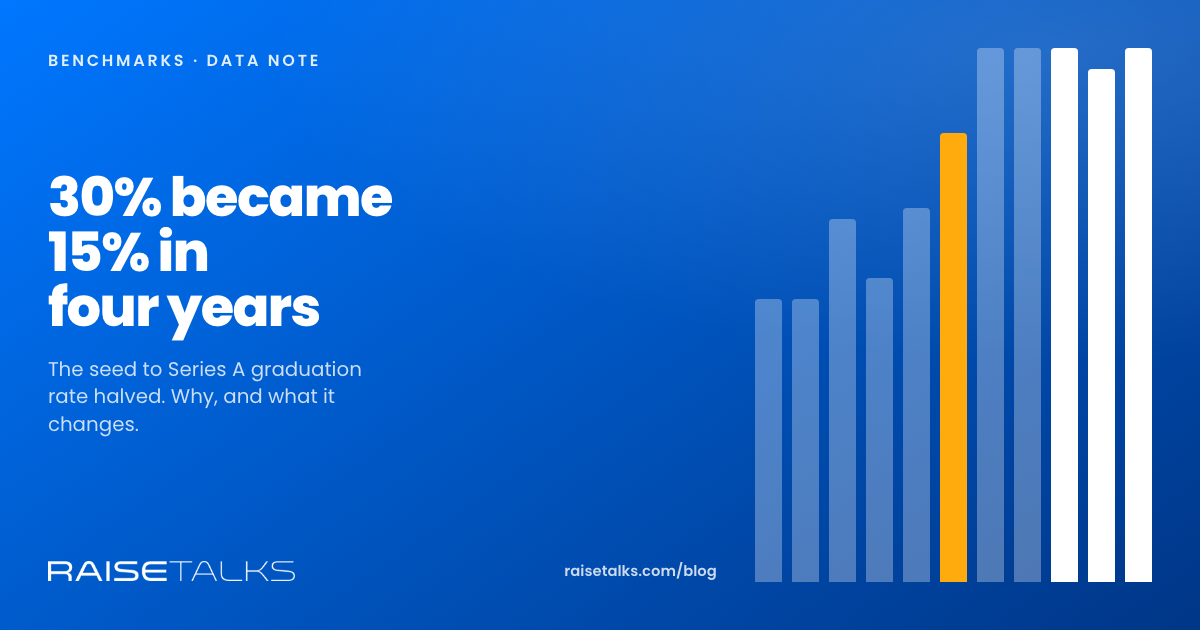
The Graduation Problem: What Share of Seed Companies Reach Series A
Roughly 15-20% of seed companies reach Series A within 24 months, down from 30% in 2018. The data, why it halved, and what it changes.
How investors evaluate early-stage startups: data rooms, diligence, benchmarks, and the work that moves a round to a term sheet.
Roughly 15-20% of seed companies reach Series A within 24 months, down from 30% in 2018. The data, why it halved, and what it changes.
Sharing everything is reckless and sharing nothing is slow. The four-tier access model, and why enforcement has to sit below the interface.
A one-page investment memo for pre-seed and seed: the nine blocks, what has to be falsifiable, and why you write it before the decision.
The four dimensions every early-stage investor assesses, what separates a 2 from a 4 in each, and why three strong dimensions and one weak one still fails.
Three to six months end to end. The 2026 timeline by phase, the single variable that halves it, and why founders plan for half the duration.
The eleven gaps that most often stall early-stage diligence, ranked by how expensive they are to fix late, and the specific action that closes each one.
A pre-seed diligence checklist sized to a pre-seed cheque: what to verify in days, what to skip, and the four items that are never optional.
The warm intro is a proximity filter, not a quality filter. How to build investor interest that does not depend on who you already know.
Warm-intro-only dealflow is rational per deal and costly per portfolio. The economics of the deals you never see, and why the loss is invisible.
Enthusiasm is not a term sheet. The nine things investors need between a good first call and a written offer, and why most are documentation.