The Readiness Gap: Nine Things Founders Miss Between Interested and Term Sheet

The most frustrating pattern in fundraising is not rejection. It is enthusiasm that goes nowhere. A great first call, genuine interest, a promised follow-up, and then the conversation simply cools over three weeks with no stated reason.
Almost always, something specific was needed and either never asked for or never supplied. These are the nine things that most often sit in that gap.
Key takeaways
- Investors rarely say "I am blocked on X". They go quiet, and you interpret it as a soft pass.
- Seven of the nine gaps below are documentation, not business performance.
- The deal dimension is the most common blocker: no coherent transaction to say yes to.
- Velocity is itself evidence. A 48-hour response time during diligence reads as a signal about the company.
- Pre-empt all nine before your first call and the gap mostly disappears.
1. A coherent deal
In our experience, the most common blocker.
An investor cannot write a term sheet against "we are raising about a million and a half". They need: amount, instrument, valuation or cap, minimum cheque, who else is in, whether there is a lead, target close date.
Founders leave this vague deliberately, hoping to keep options open. The effect is the opposite: there is nothing for the investor to react to, so they wait. Vagueness reads as "not ready", not as "flexible".
2. A cap table that reconciles
Discussed at length in data room red flags, and worth repeating here because of where it lands in the timeline.
The investor does not raise it as a problem. They ask a clarifying question, get an answer that does not quite resolve, and quietly downgrade the opportunity. You never hear that this happened.
3. Metric definitions
"12,000 users" invites the question "active how?". If the answer is not already written down, the investor has to ask, wait, and then decide whether the definition they receive was constructed after the question.
Write the definitions before anyone asks. One line per metric: what is counted, over what window, from what source.
4. A market size they can reconstruct
A partner who has to defend your company internally cannot do it with a number they cannot derive. They will not tell you your TAM was the problem. They will tell you it is a bit early for them.
Bottom-up, with the arithmetic shown.
5. Customer evidence
If you claim customers, be ready with contracts, usage data, or references who will take a call - before being asked.
Offering references unprompted is one of the strongest signals available to an early-stage company, and almost nobody does it. It converts a verification task into a demonstration of confidence.
6. An honest product state
An explicit shipped / in-build / planned table.
The damage from ambiguity here is asymmetric. Being early is fine. Being caught describing a roadmap item as shipped is not, and it retroactively contaminates every other claim.
7. A use of funds tied to milestones
Not "18 months of runway". What the money buys, what that proves, and why that makes the next round a reasonable proposition for someone.
This is the block that lets a partner argue for you in a meeting you are not in. Without it, your champion has to construct the argument themselves, and they usually will not.
8. Speed
Underrated as a gap because it does not feel like one.
An investor asks for the cohort data on Tuesday. If it arrives Wednesday, that is information about how the company operates. If it arrives the following Monday with an apology, that is also information.
During diligence, same-day is the standard. If you cannot hit it, the gap is that the data does not exist in a retrievable form - which is the actual problem to fix.
9. A reason to decide now
Not manufactured urgency, which is transparent and counterproductive. A real one: a lead is circling, the round closes on a date, allocation is filling, a milestone lands next month that changes the price.
Absent any reason to move, waiting is free for the investor and expensive for you. That asymmetry is the default state of every fundraising conversation, and closing it is your job.
The pattern
Seven of the nine are documentation. None of them require a single new customer.
That is the finding worth sitting with: the gap between "interested" and "term sheet" is usually a writing gap, not a performance gap. Which is good news, because writing is entirely within your control and traction mostly is not.
The pre-emption checklist
Before your first investor call, have all nine ready:
- Deal terms written down: amount, instrument, valuation or cap, minimum cheque, lead status, close date
- Cap table reconciled to every SAFE and note
- Every metric defined in one line
- Market sizing derived bottom-up with the arithmetic visible
- Customer evidence assembled, references identified
- Shipped / in-build / planned table written
- Use of funds mapped to milestones and to the next round's bar
- All source data retrievable same-day
- A real, stated reason the timeline matters
A day of work. It converts a three-week cooling period into a decision.
Frequently Asked Questions
Usually something specific was needed and not supplied, and they did not consider it worth the email. Occasionally it is a genuine pass they are avoiding stating.
A short thank-you, the specific items discussed, and access to your full record at basic tier. Same day.
State facts: a close date, a lead's timeline, allocation remaining, a milestone that will change the price. Never invent them.
Five to seven working days, then a direct question: "Is this something you are likely to pursue, or should I stop taking up your time?" Clear answers are worth more than warm silence.
Read next
 The Fundraising Readiness Score: How Investors Rate You Before the First Call
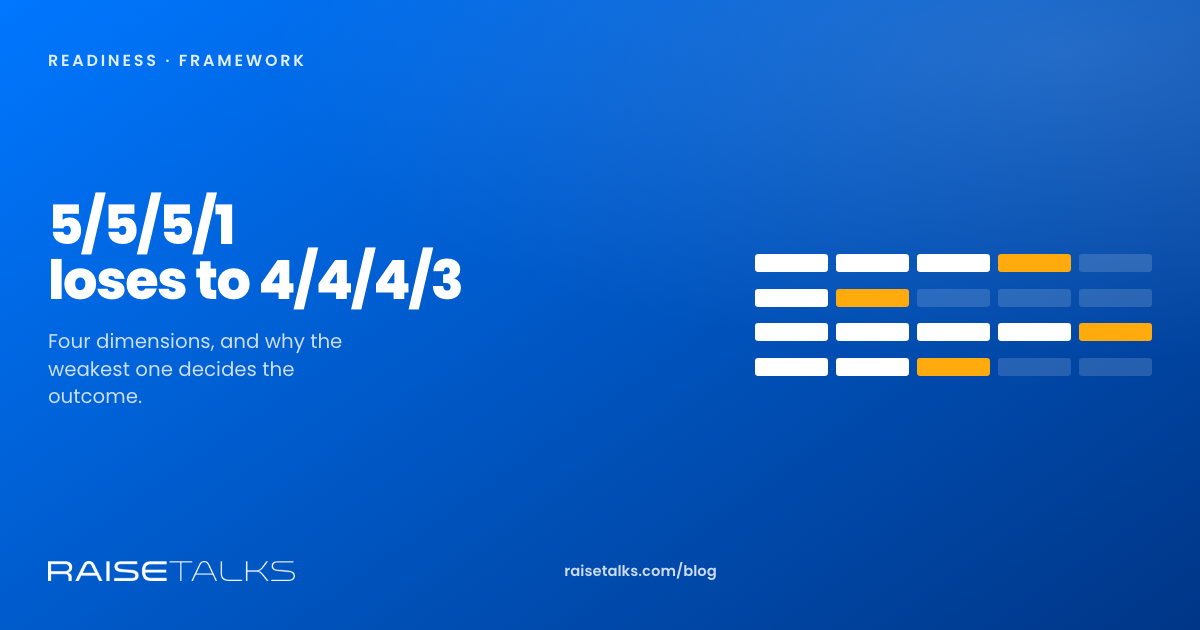 Team, Product, Market, Deal: The Four Dimensions of a Fundable Company
 Data Room Red Flags: The 11 Gaps That Stall Due Diligence
 Run Your Raise as a Pipeline: The 10-Stage Fundraising CRM
RaiseTalks holds the documentation behind seven of the nine in one structured record and tells you which sections are still incomplete before an investor finds out. Start your 30-day trial.